01 · Summary
North Devon Council (NDC) should refuse planning application 82141. The applicant's own documents do not show that a 176,000-bird broiler unit can operate at Higher Hall Farm without harm to neighbours, ancient woodland, Exmoor and the village of Brayford

02 · The proposal
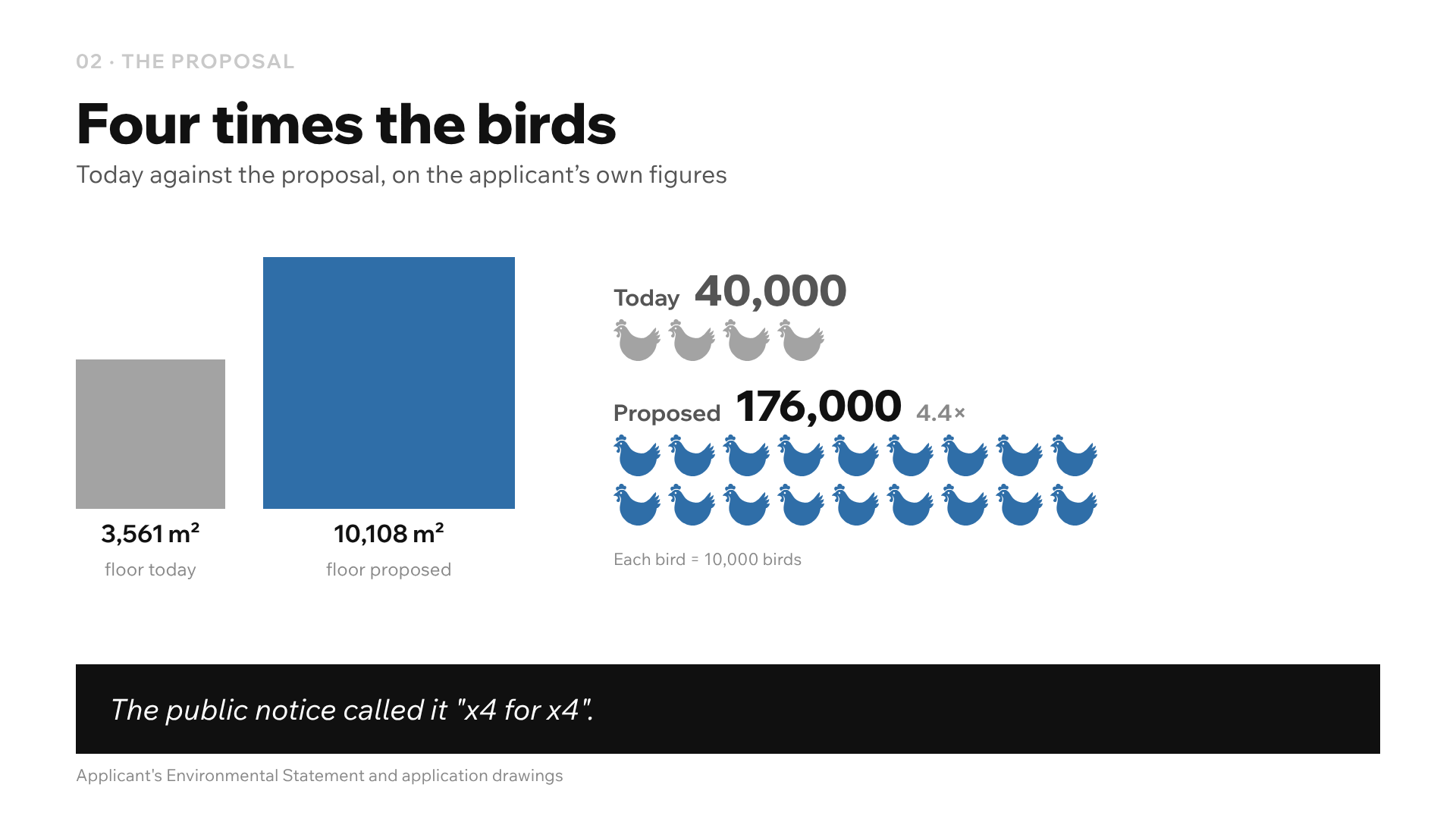
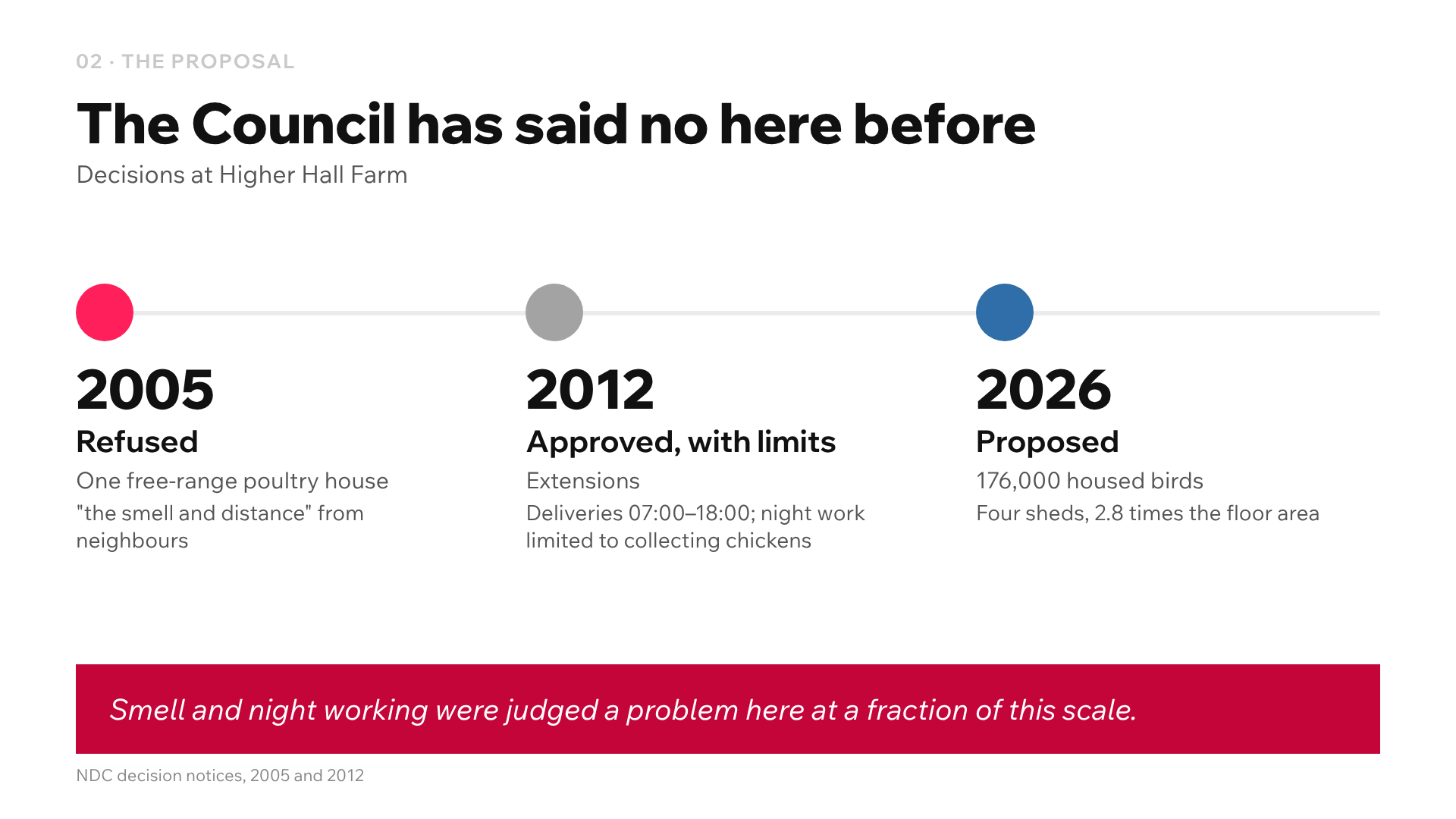
The applicant seeks to demolish four free-range poultry houses and build four new broiler sheds, each about 103 m long and 24 m wide, for 176,000 birds. A separate environmental permit is sought from the Environment Agency.


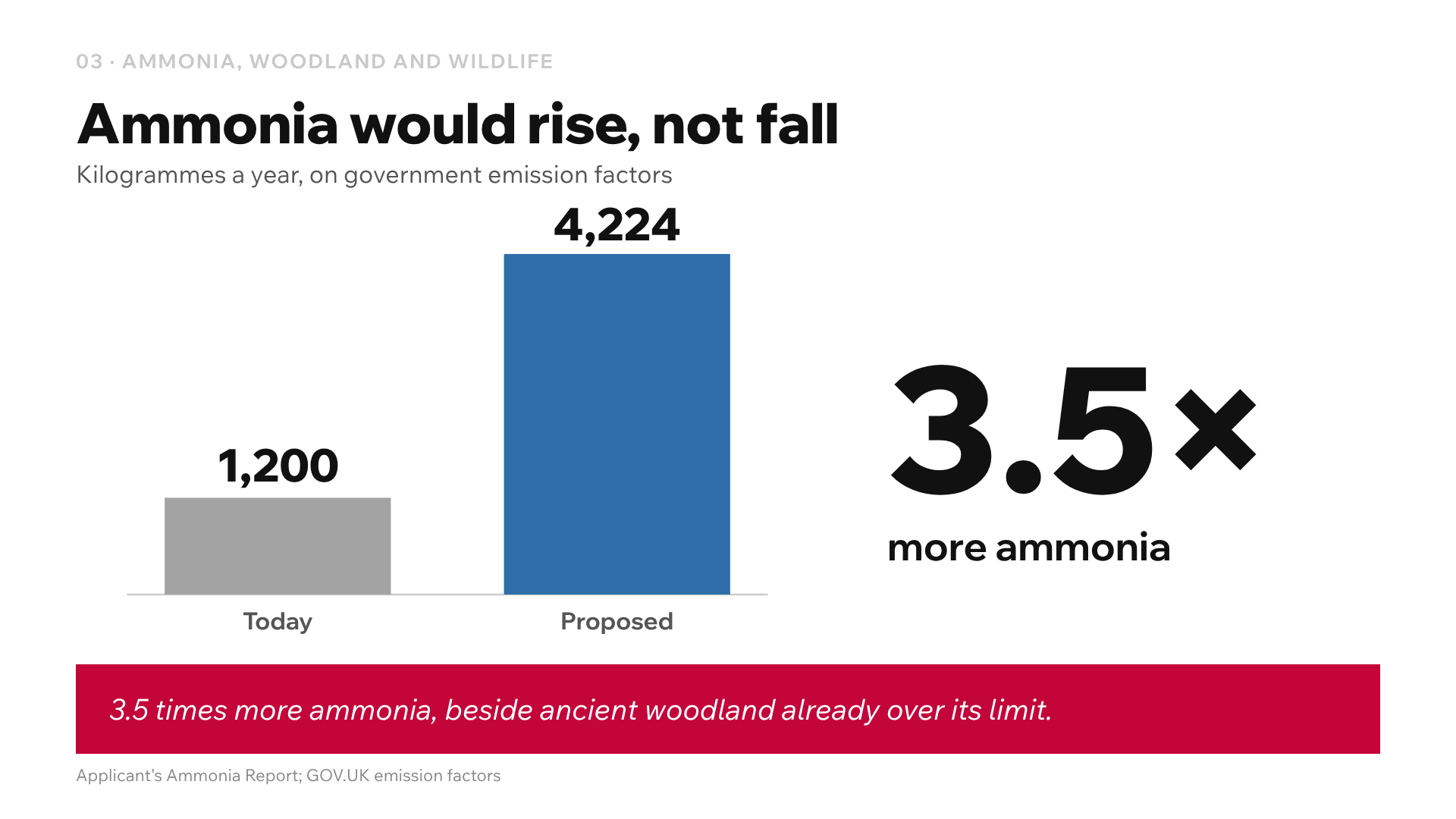
On the government's own emission factors, the new farm would give off about 3.5 times as much ammonia as the farm does today. The applicant's figures present it as an improvement, giving off about 2% less. This is incorrect.
03 · Ammonia, woodland and wildlife
04 · Odour
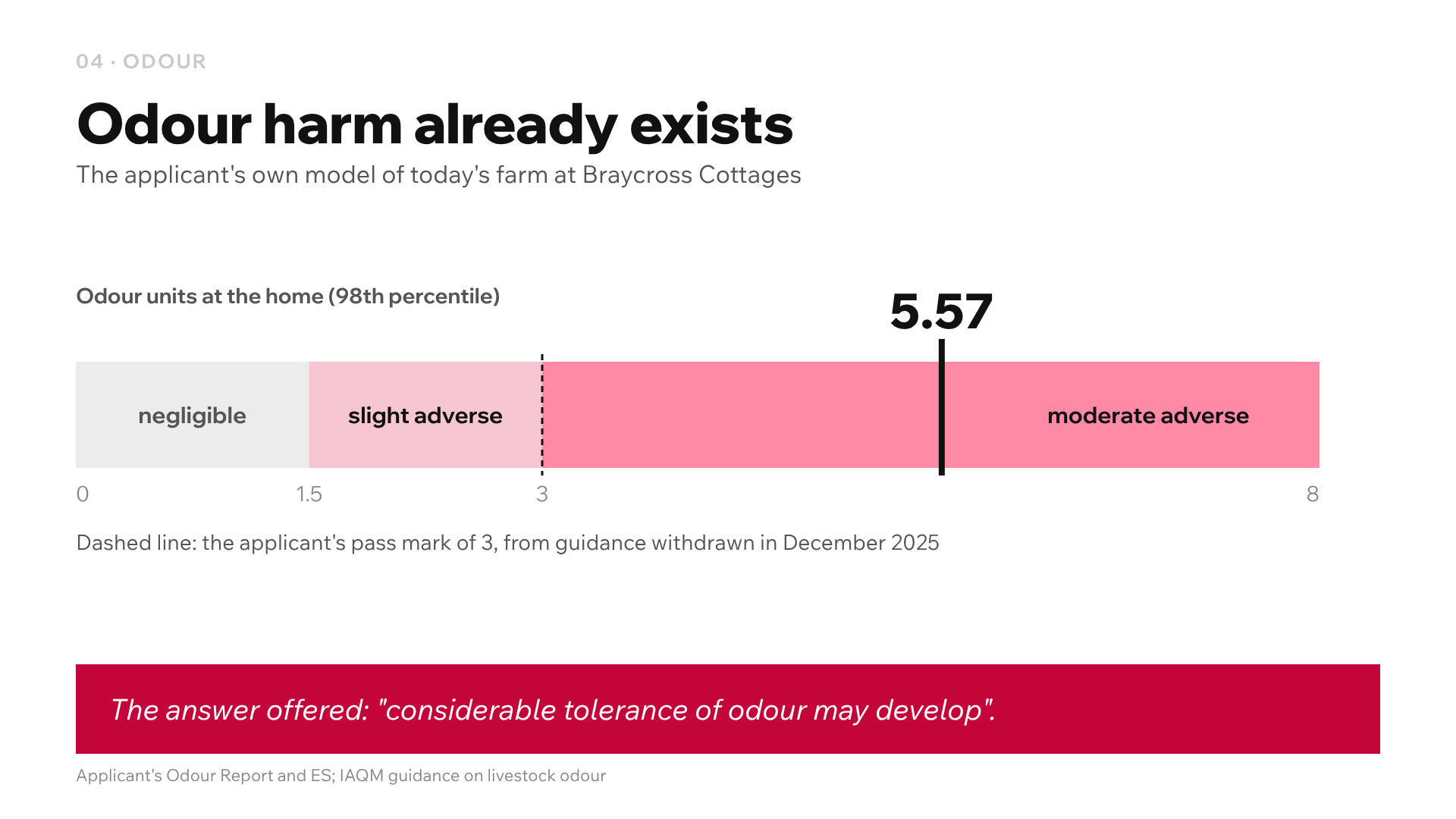
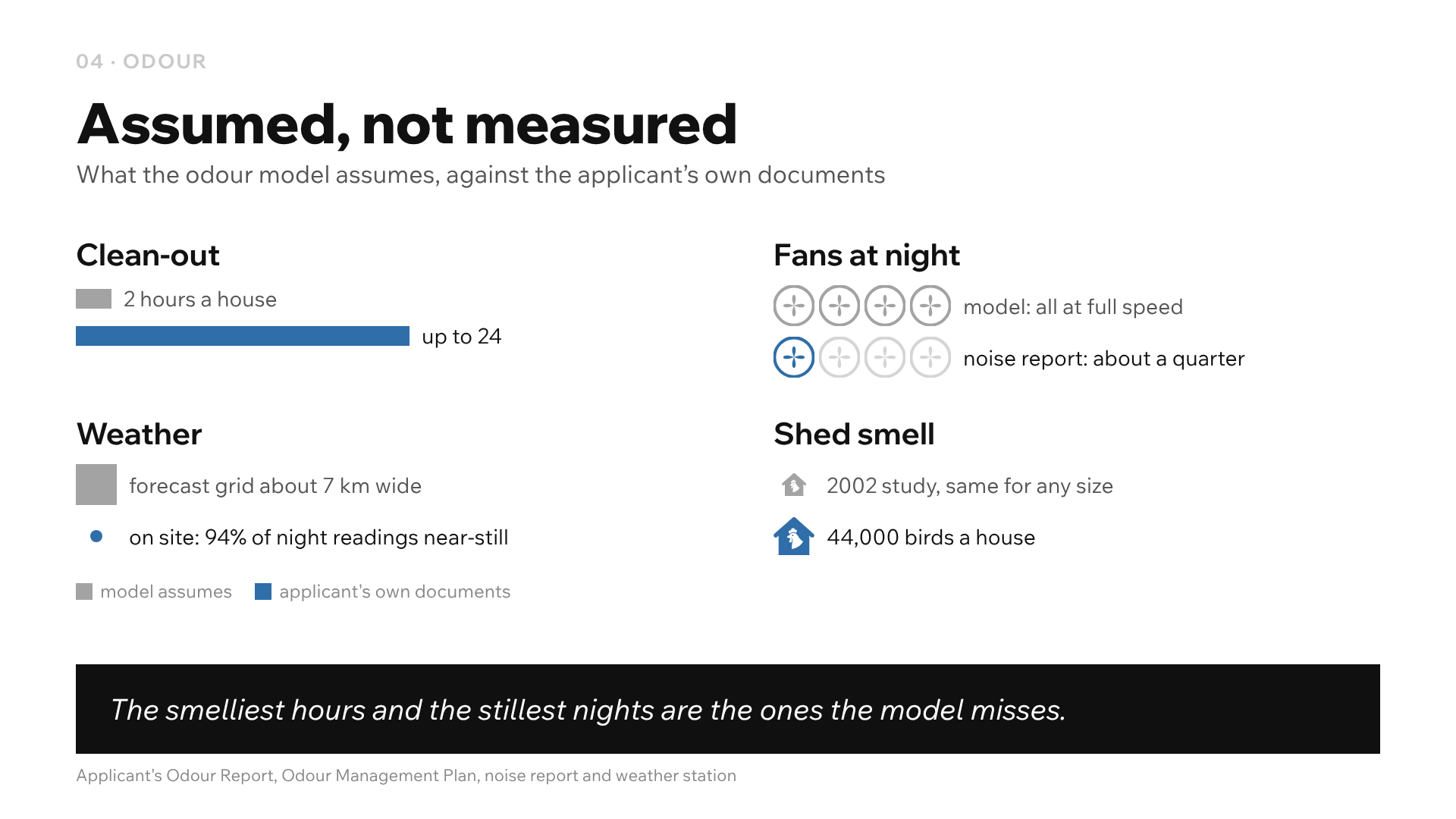
The applicant predicts that odour will fall at most homes, although bird numbers rise 4.4 times. That prediction is judged against a benchmark that no longer exists, rests on assumptions rather than measurement, and leaves out the places nearest the sheds.


05 · Night-time noise, catching and thinning
The noise report assesses the ventilation fans only. It leaves out lorries, loading and bird catching because, it says, the development "will not result in any change to the frequency or nature of transport movements" [1]. The applicant's own figures show lorry trips per crop more than doubling (see Lorries), and its EA noise assessment states "Bird catching frequently occurring during night time", with reversing alarms during night catching [2].

06 · Lorries through Brayford
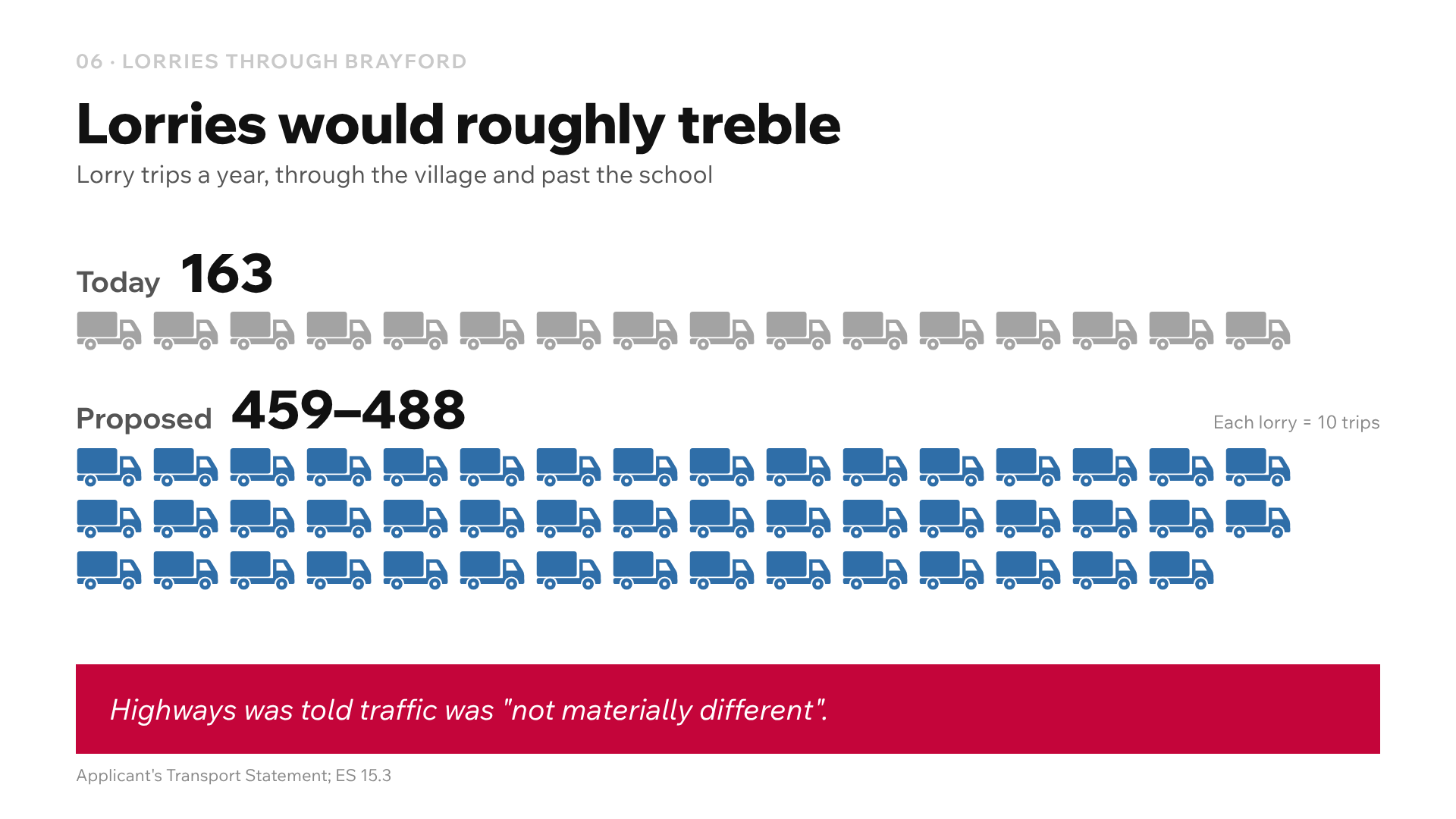
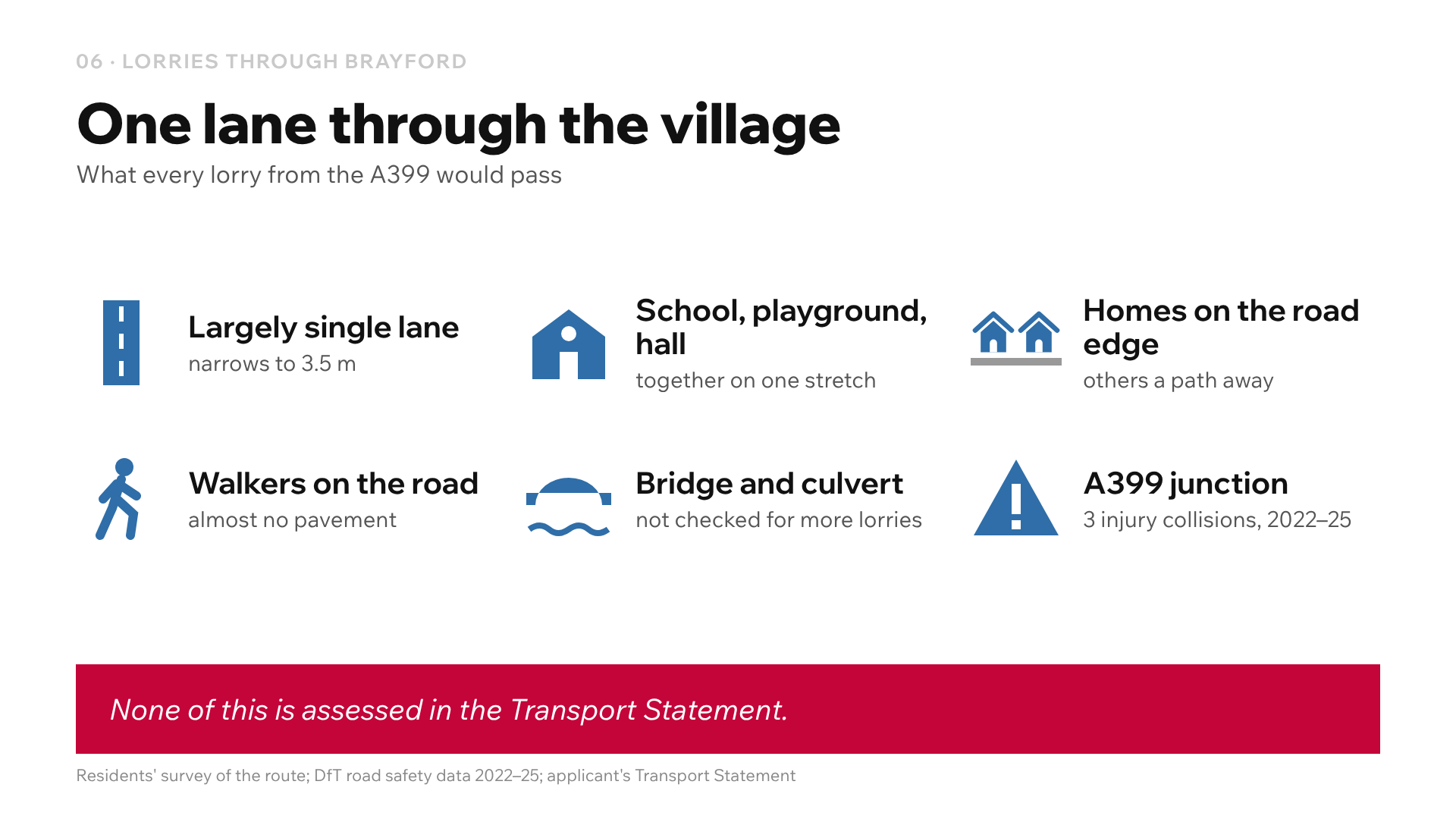
On the applicant's own figures, lorry and tractor-trailer trips would rise from about 163 a year to 459–488, nearly three times today. Devon County Council (DCC) Highways raised no objection because it was told the traffic was "not considered to be materially different than the existing"


07 · Manure: where does it go?
The farm would produce roughly 1,800 to 3,200 tonnes of used litter a year, and the application does not say where any of it goes. That figure is scaled from two comparable poultry units, at 11 and 18 tonnes per 1,000 birds a year because the applicant doesn't state how. It would contain roughly 33 to 58 tonnes of nitrogen a year.

08 · Water, drainage and groundwater
The drainage scheme would soak run-off from about 1.7 hectares of roofs and yards into the ground above a sensitive aquifer. The report that should justify it is missing, and the figures that are available are inconsistent.

09 · Exmoor, landscape, night skies and tourism
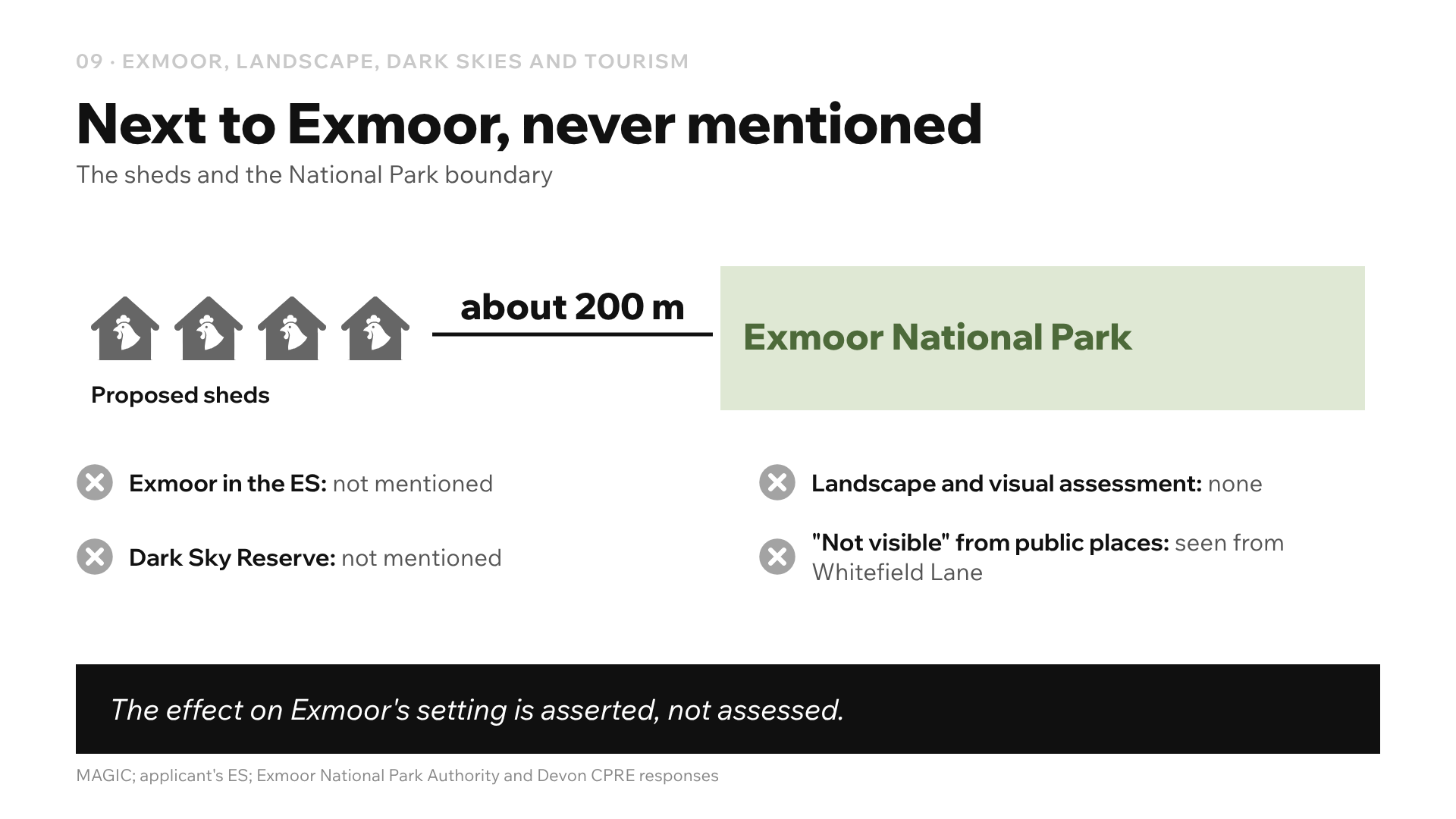
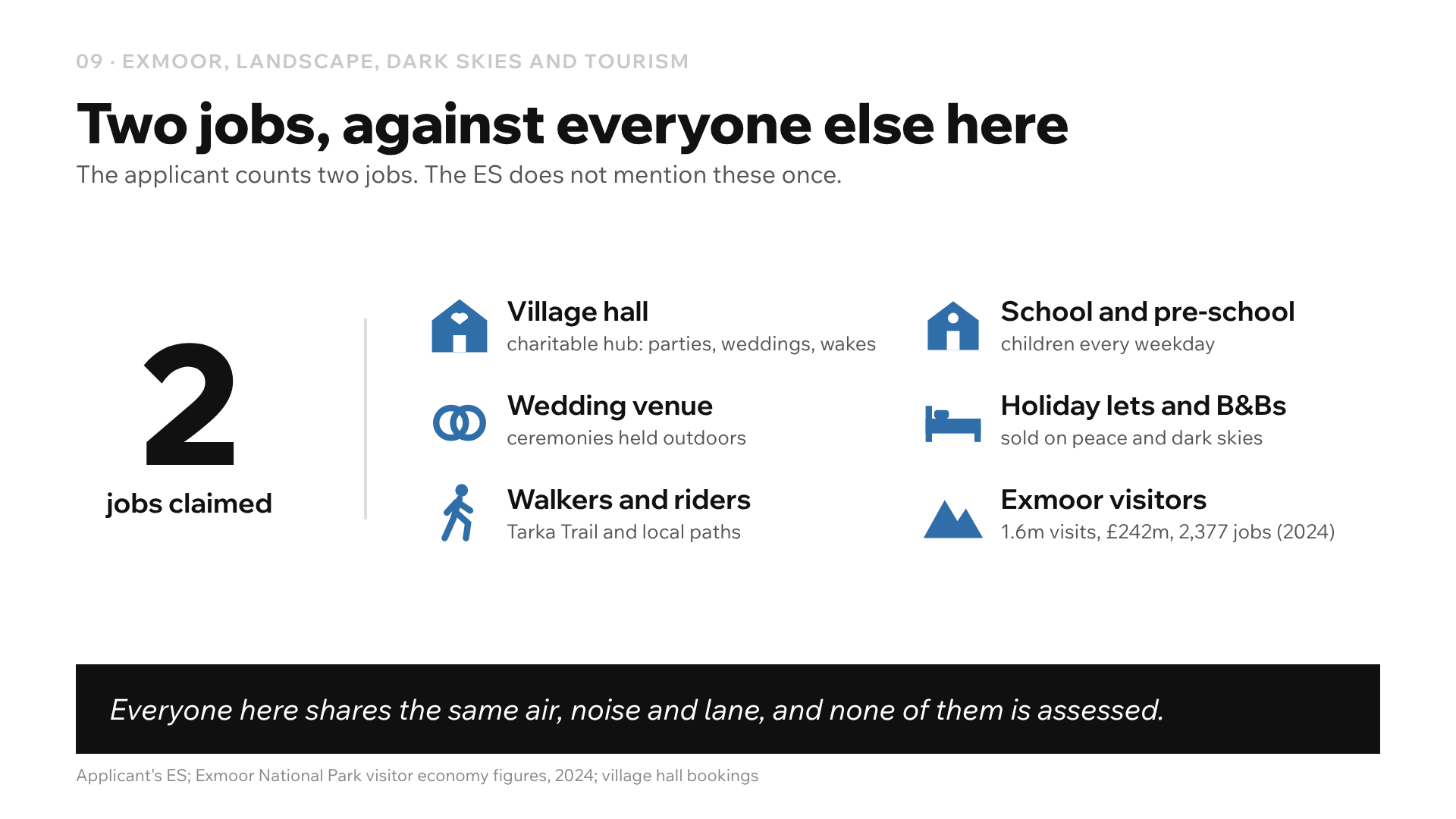
The Environmental Statement admits a "moderate adverse residual visual effect" but calls it "not a significant change" [1]. It reaches that view without a landscape and visual impact assessment (LVIA), without viewpoints, and without once mentioning Exmoor National Park, so the effect on Exmoor's setting is asserted, not assessed.


10 · Gaps in the environmental statement
A unit of more than 85,000 broilers must have an Environmental Impact Assessment (EIA). NDC cannot grant permission without examining the Environmental Statement and reaching a reasoned conclusion on the significant effects [29]. The statement supplied falls short of what the law requires.

11 · Health
The application treats health as a food-safety question. It does not assess what neighbours, visitors and schoolchildren would breathe or hear. National policy requires decisions to take account of the effects of pollution on health and living conditions, including "where certain groups could be particularly vulnerable... such as children and older people"

12 · Brayford quarry and combined effects
The application assesses the farm on its own, as if nothing else affected the same air, roads and people. The law requires an Environmental Statement to assess cumulative effects with other existing and approved projects. This one does not.

13 · Emergencies
The law requires an Environmental Statement to assess the risks of accidents and disasters [29]. This one covers disease only through the food chain, and the permit documents rate every hazard "Not significant".

14 · After an approval, who protects the residents?
If permission and an EA permit are granted, residents will depend on the permit rules and making complaints for protection from harm. Experience elsewhere shows how weak that protection can be, which is why the planning decision matters.

15 · The offical responses: what they relied on and what they did not address
Several consultees raised no objection. Between them, the five that did leave 22 errors, omissions or inconsistencies unaddressed, and Natural England's response leaves four more: 26 across six responses. Each response rests on the applicant's documents, and each relied on figures or premises that this report shows to be wrong or incomplete. A "no objection" carries weight only for the reasons that it gives based on facts it judges. In the Footbridge Farm appeal, the inspector held that the regulatory officers' lack of concern "does not alter my findings", and that Natural England's non-objection did not change the harm found. All responses are on the public file.

16 · We ask North Devon Council to refuse the application
Because the applicant has not shown that it would avoid:
-
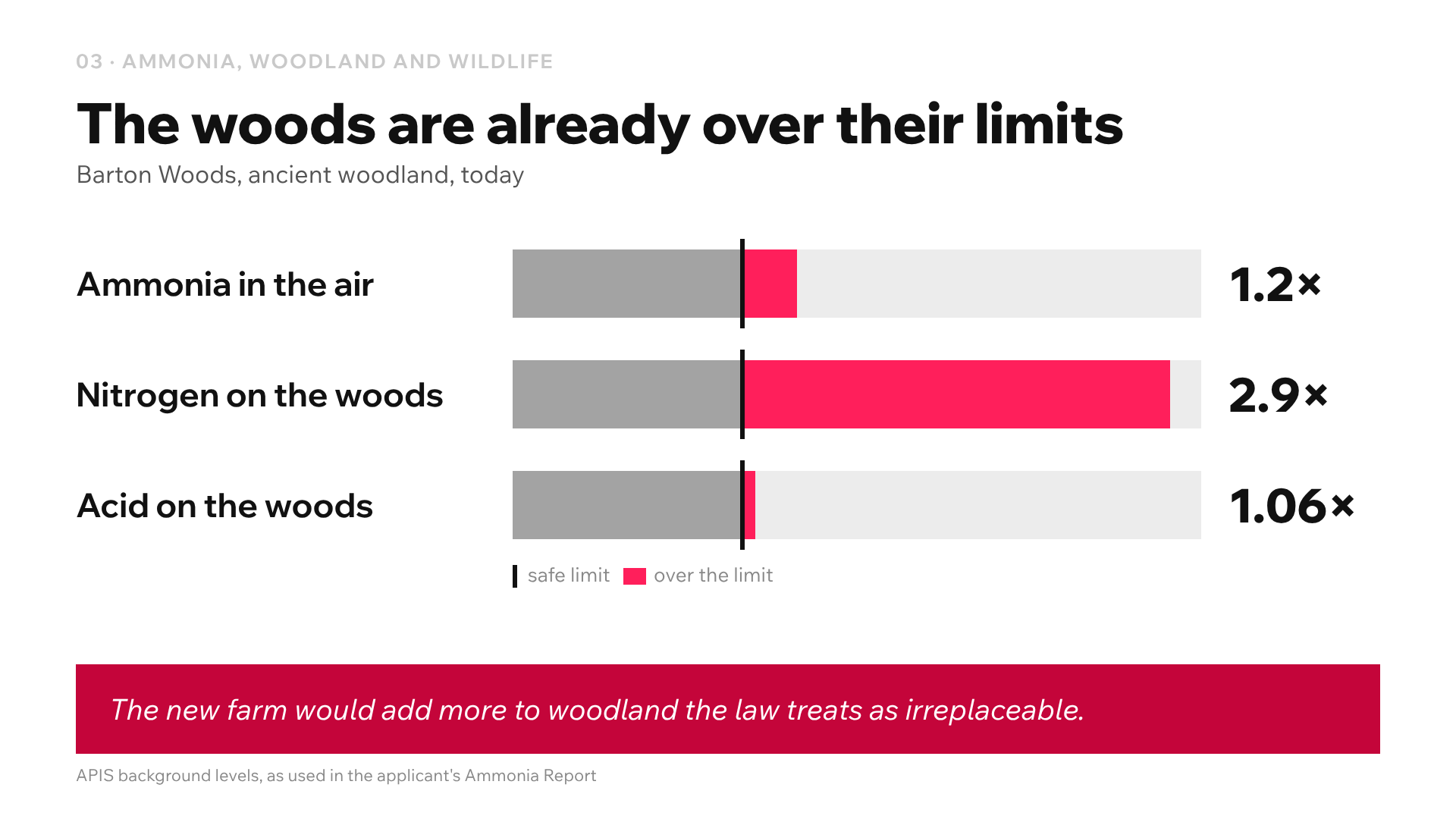
further harm to ancient woodland already above its safe limits, and to Exmoor's protected sites, assessed alone and in combination;
-
unacceptable odour, night-time noise, dust and traffic for neighbours, visitors, Brayford Academy and the village;
-
risk to groundwater and to a drinking-water catchment;
-
harm to the setting of Exmoor National Park and its dark skies.

Read the report for full details
Find out how we determined that ammonia would rise; that odour assesments rest on assumptions; how night time activity is largely left out; that lorries will treble; what the issues with manure disposal are; the concerns over drainage; impacts on the local landscape and Exmoor national park; the potential risks to resident's health, particularly the very young and old; how official "no objection" responses have been made against missing information; and how the planning application itself is flawed.